 promerget.ai
Forty percent grunt work, one hundred percent banker pricing
Whether AI will replace M&A advisors is the wrong question. It has been asked on every panel for two years anyway, and both camps are wrong.
The right question is: what is an M&A fee actually paying for? Break it down cleanly, and you see immediately which part of this industry will be gone in eighteen months and which part stays untouchable.
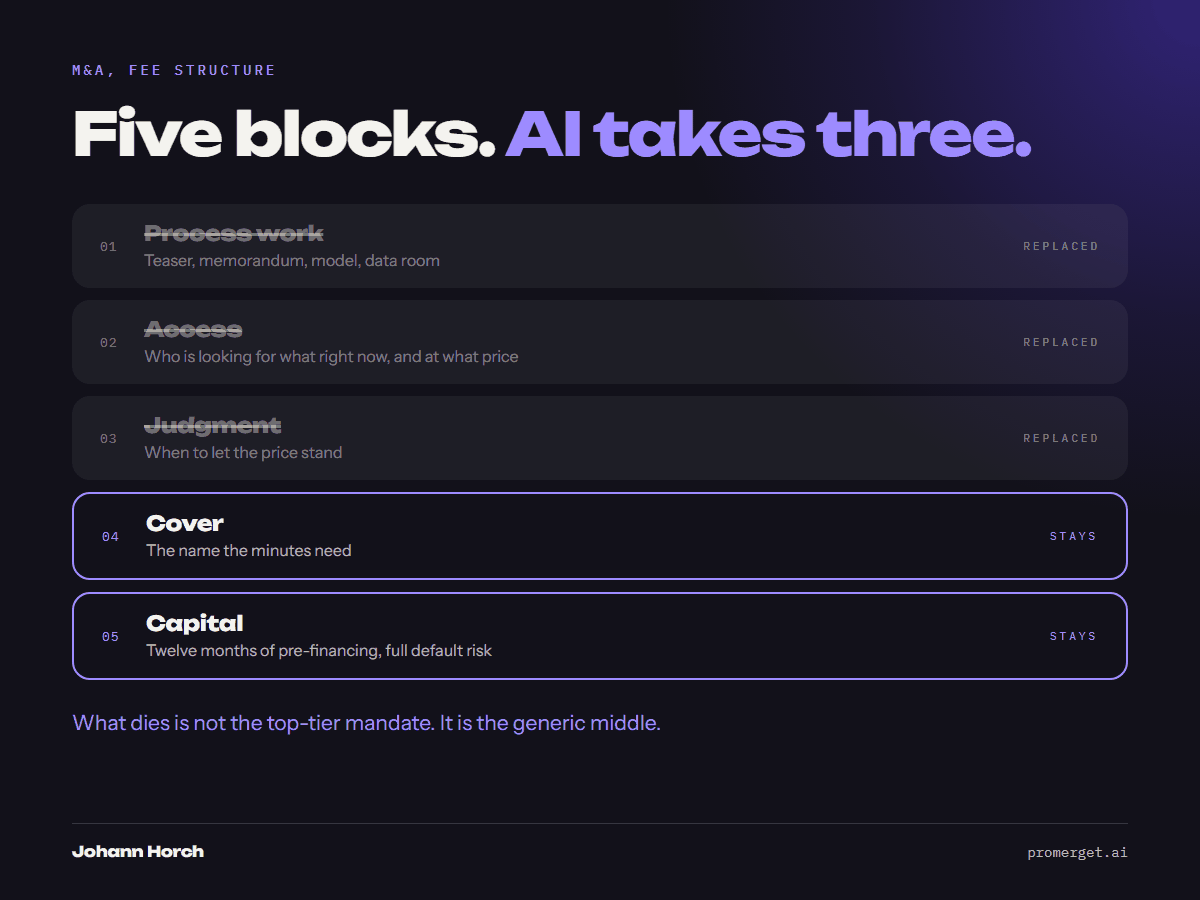
Five blocks.
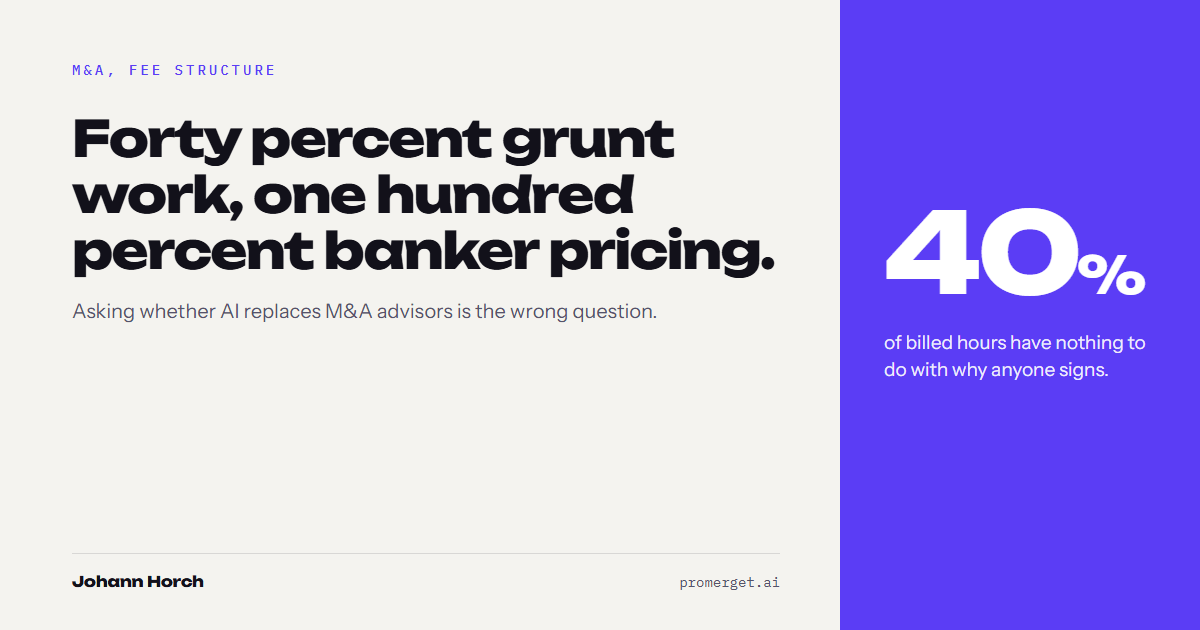
Process work. Teaser, information memorandum, model, longlist, data room, Q&A management. Roughly forty percent of billed hours. And roughly zero percent of the reason anyone signs in the end.
Access. Which partner at which fund is looking for which theme right now. Who did not spend their budget last quarter. Who only buys if the founder stays. None of that is in any database.
Judgment in the negotiation. When to let the price stand and when to get up and leave.
Cover. The shareholder, the advisory board, the investment committee need someone to confirm that a proper process was run and the price was at market. Not for the decision. For the minutes.
Capital. A pure success fee means the advisor pre-finances twelve months of work and carries the default risk alone. The advisor is a financier, not just a service provider.
What AI takes
Block one completely. Block two partially. Block three at the edges.
Blocks four and five not at all.
Cover is not an information problem; it is a social one. An advisory board does not want a better data room. It wants a name it can cite in the minutes when the deal goes wrong three years later. That cannot be automated, and it will not be. Pre-financing, in turn, is a balance-sheet issue. No model and no automation helps there.
Anyone who claims AI replaces M&A advice has never been in the room when a shareholders' meeting makes a price decision. I have been there often enough. In that room the numbers are long settled. What is being negotiated is something else entirely.
What really dies
Not the top-tier mandate. The generic middle.
Firms without their own sector access, without their own buyer relationships, whose output is essentially grunt work at banker prices. Their reason to exist was labor. In eighteen months, that labor costs a tenth.
You can see the industry's line of defense in what it does not offer. Nobody sells the final stretch of a process on its own. Nobody sells a second opinion before the binding offer as a standalone service. Not because nobody asks for it, but because the cost base of a team of six analysts and a partner only carries the full package. A bundle held together by supplier discipline rather than customer demand has always broken apart.
What emerges
The real effect is not displacement. It is market creation.
The same cost base forces minimum fees. That is why below roughly ten million in enterprise value there is practically no offering in Germany. A company that changes owners for four million gets no professional process. Not for lack of demand. For lack of a service that pays for itself.
These deals happen anyway. At the kitchen table, with the tax advisor, with exactly one interested buyer, without comparing alternatives, without price discipline. The owner regularly loses a significant part of the value and never finds out, because the reference points to notice are missing.
That is exactly what the trust apparatus does: it does not prevent bad advice. It prevents bad advice from becoming visible.
And this owner does not need a name for the minutes. This owner needs a result.
Where we are strong
promerget works where a classic cost base does not pay off: small tickets at high frequency. Buy-and-build with many add-ons instead of one big process a year. Sector depth instead of industry breadth.
This is not theory. In three years I negotiated and integrated ten acquisitions. Seven brands, ten sites, five countries, three hundred people onto one platform. Then the exit to a financial investor. I know what the twelfth month of integration costs when nobody is listening anymore.
Where we are not strong
I do not have a name that carries weight in a supervisory board's minutes. I do not have a balance sheet that pre-finances twenty processes in parallel. And I do not have a partner relationship with every fund in Europe.
Anyone who claims the opposite about themselves is selling exactly the camouflage I accuse this industry of.
That is why I am looking for partners. Three profiles, cleanly separated:
A law firm with transaction strength for the document end stretch. Final review of the SPA, signing and closing support, a second opinion before binding offers. Fixed fee or hourly rate, no mandate lead, no exclusivity.
A senior advisor as a person, not an institution. Thirty years of transaction experience, no banker cost base left to cover. Title, a share in the success, real presence at the critical meetings.
A financing partner for platform capital. With a clear mandate of its own at company level and a full role. Not as a supplier.
The answer
The old model survives. At the top, where cover is needed and capital is pre-financed, it is hard to attack. Whoever sits there has the next ten years ahead of them.
It just will not come back to where it never was. And that is exactly where a market is emerging right now.
I am building in that market. If you fit one of the three profiles, write to me.